Why Forgiveness Might Be Your Most Underused Leadership Tool

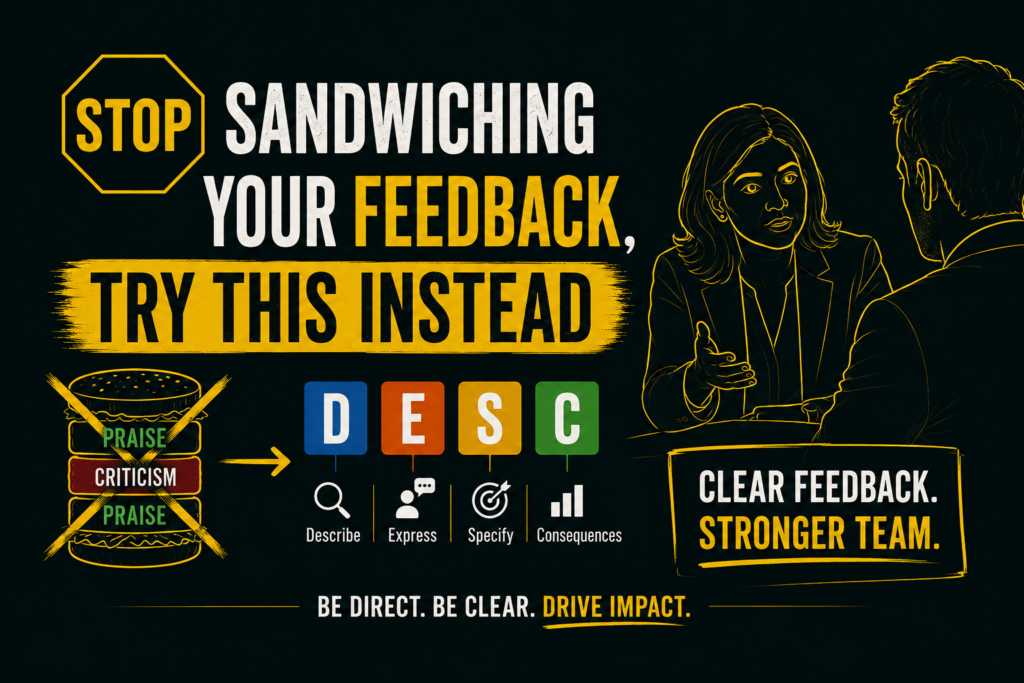
Praise. Criticism. Praise.
It sounds like the kind approach.
Start with something positive. Deliver the difficult message. End with another compliment.
The feedback sandwich has become a familiar technique for managers who want to make difficult conversations feel less uncomfortable.
But there is a problem.
Sometimes, in trying to make feedback easier to hear, we make it harder to understand.
Gallup workplace data cited in the original article reports that only 26% of employees find the feedback they receive effective, while just 16% describe their last manager conversation as truly meaningful. The article also cites research associated with Columbia University professor Kevin Ochsner suggesting that feedback drives real improvement only around 30% of the time.
So perhaps the question isn’t:
“How can I make this feedback sound nicer?”
It is:
“How can I make this feedback clear enough to create change?”
Why the Feedback Sandwich Doesn’t Always Work
The intention behind the feedback sandwich is understandable.
Managers don’t want to hurt someone’s feelings. They want to maintain the relationship and make criticism easier to accept.
But placing criticism between two compliments can sometimes bury the actual message.
An employee might focus on the praise, become anxious waiting for the criticism, or leave the conversation unsure about what they actually need to change.
As the original article highlights through Roger Schwarz’s work, sandwiching criticism doesn’t necessarily protect the message. It can dilute it.
The issue isn’t that managers are too caring.
Often, they simply aren’t being assertive enough.
Directness can feel uncomfortable, particularly when the manager is concerned about damaging the relationship.
But effective feedback doesn’t need to be harsh.
It needs to be specific, respectful and actionable.
Try the DESC Model Instead
One practical alternative is the DESC model:
Describe → Express → Specify → Consequences
It gives managers a simple structure for having difficult feedback conversations without hiding the message behind unnecessary praise.
D — Describe
Start with the facts.
Describe what happened without attaching a judgment to the person.
Instead of:
“You’ve been careless.”
Say:
“You’ve missed the last three sprint deadlines.”
The first statement labels the person.
The second describes the behaviour.
E — Express
Explain the impact.
For example:
“This has meant the team absorbs the delay, and I’ve had to explain the slippage upward.”
This helps the employee understand why the behaviour matters.
S — Specify
Be clear about what needs to change.
For example:
“Going forward, I need deadlines flagged 48 hours in advance if they’re at risk.”
Don’t leave the employee guessing about what “do better” actually means.
C — Consequences
Make the implications visible.
Consequences don’t have to be punitive.
For example:
“If we get ahead of this, it protects your bandwidth on the projects that matter most to your growth this quarter.”
This connects the desired behaviour with a meaningful outcome.
Suggested Visual: The DESC Model
I recommend presenting the four DESC stages as a branded step-by-step infographic, with each stage paired with its example statement.
What Makes This Approach Different?
Notice what is missing.
No praise buffer.
No vague statements.
No personal labels.
No unnecessary harshness.
Instead, the employee gets four things:
- What happened.
- Why it matters.
- What needs to change.
- What happens next.
That is what assertive communication in the workplace should achieve.
The purpose of feedback isn’t to make the manager feel comfortable delivering it.
It is to help the employee understand what they can do differently.
Clear Feedback Is Not Cruel Feedback
There is an important distinction between being direct and being disrespectful.
Direct feedback attacks the issue.
Poor feedback attacks the person.
Compare:
“You’re unreliable.”
with:
“The last three deadlines were missed. I need you to flag risks earlier so we can address them before the deadline.”
The second statement is still difficult to hear.
But it gives the employee something they can actually work with.
That’s the real goal of effective manager feedback:
Clarity without hostility.
Final Takeaway: The Next Time You Need to Give Difficult Feedback
Before your next feedback conversation, ask yourself:
“Am I softening this because the employee needs it, or because I am uncomfortable saying it?”
Then use DESC:
Describe the behaviour.
Express the impact.
Specify the change.
Explain the consequence.
You don’t need to surround a difficult message with compliments to make it constructive.
Sometimes, the most respectful thing a manager can do is simply say the difficult thing clearly.
Because effective feedback isn’t about making criticism easier to hear.
It’s about making improvement easier to understand.