Stop Sandwiching Your Feedback: Try This Instead

What if the biggest drag on your team’s performance isn’t a skills gap, but a memory that won’t let go?
Leadership conversations are full of accountability.
KPIs. Performance reviews. Difficult conversations. Corrective feedback.
But there is one part of leadership that often gets less attention:
What happens after the mistake?
After the missed deadline.
After the client complained.
After the project went wrong.
After an employee made a decision that had consequences.
Holding people accountable is an important part of effective leadership. But accountability becomes counterproductive when an employee is never allowed to move beyond their mistake.
Sometimes, the mistake ends.
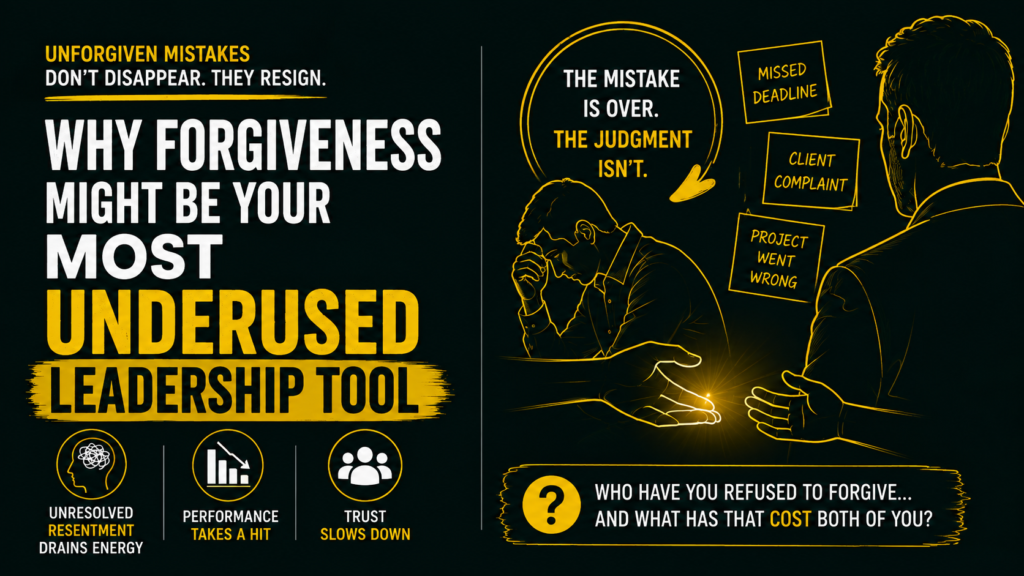
The judgment doesn’t.
When One Mistake Becomes Someone’s Identity
Think about your own team.
Is there someone you’ve quietly labelled as:
“The one who messed up.”
Maybe they have learned from what happened.
Maybe their performance has improved.
Maybe they have demonstrated that they can be trusted again.
But do you still see them through the lens of that one moment?
This can happen more easily than we realise.
A previous mistake can influence who gets trusted with important work, who receives opportunities and who gets the benefit of the doubt.
The original article highlights a workplace health study in which employees who struggled to forgive workplace offenses showed 35% higher unproductive workplace behaviour, along with higher psychological distress and more physical health complaints.
The broader leadership lesson is important:
Unresolved resentment doesn’t necessarily stay in the past. It can influence future workplace behaviour and relationships.
Forgiveness Does Not Mean Lowering Accountability
This is where many leaders become uncomfortable.
“So, are we supposed to ignore mistakes?”
Absolutely not.
Forgiveness in leadership is not about pretending that something didn’t happen.
It is not about removing consequences.
And it is not about accepting repeated poor performance.
Instead, accountability and forgiveness serve different purposes.
Accountability asks:
“What happened, and what needs to change?”
Forgiveness asks:
“Has that change happened, and am I willing to see it?”
Suggested Visual: Accountability vs Forgiveness
I recommend presenting these two questions as a side-by-side branded infographic, showing how accountability and forgiveness work together.
You can hold someone accountable while still believing in their ability to grow.
In fact, effective leadership often requires both.
Accountability addresses the behaviour.
Forgiveness allows the person to move beyond the behaviour once genuine change has occurred.
The Cost of Holding On
Imagine an employee makes a significant mistake.
The manager addresses it. The employee understands what went wrong, takes responsibility and changes their approach.
But six months later, the manager still thinks:
“I don’t trust them anymore.”
The employee may not hear those exact words, but they can experience the consequences.
- They may receive fewer responsibilities.
- Their ideas may be questioned more heavily.
- They may stop volunteering for challenging projects.
Eventually, the employee may begin to think:
“No matter what I do, my manager will always see me as the person who made that mistake.”
This is where unresolved resentment can quietly affect employee engagement, trust and workplace culture.
The problem is no longer just the original mistake.
It is the story that continues to be attached to the person.
From Mistake to Identity
One of the biggest leadership risks occurs when a manager stops evaluating a behaviour and starts defining the person by it.
It sounds like:
“He’s unreliable.”
“She’s difficult.”
“I don’t trust them anymore.”
The problem with these labels is that they leave little room for change.
A more constructive leadership approach separates the person from the behaviour.
Instead of:
“You’re unreliable.”
Consider:
“The deadline was missed. What needs to change so this doesn’t happen again?”
The first statement defines the person.
The second addresses the behaviour.
That distinction matters because employees need to know that growth is possible.
If every mistake permanently changes how a manager sees them, employees may become more cautious, defensive or disengaged.
And when people stop believing they can rebuild trust, they may stop trying to rebuild it.
What Does Forgiveness Look Like in Leadership?
Forgiveness at work does not necessarily require a dramatic conversation.
Often, it is reflected in what you do next.
If an employee has acknowledged a mistake and demonstrated change, ask yourself:
“Am I still treating them as though the mistake is happening today?”
If the answer is yes, consider whether your response is still serving a legitimate accountability need, or whether resentment is influencing your leadership.
You might begin by:
1. Rebuilding Trust Gradually
Give the employee appropriate opportunities to demonstrate that they have changed.
2. Recognising Improvement
Don’t allow one mistake to erase months of better performance.
3. Separating Past Behaviour From Present Performance
Evaluate the person based on current evidence, not only historical memory.
4. Giving People a Path Back
If accountability has been addressed and expectations are clear, employees should know what rebuilding trust looks like.
Forgiveness doesn’t mean forgetting.
It means choosing not to let the past permanently determine the future.
The Leadership Question Worth Asking
Sometimes the biggest barrier to team performance isn’t capability.
It is unresolved resentment carried from one conversation to the next.
This is why forgiveness deserves a place in conversations about leadership development, emotional intelligence and workplace culture.
A manager’s job is not simply to identify what went wrong.
It is also to recognise when someone has learned, changed and earned the opportunity to move forward.
So the next time you find yourself thinking:
“I don’t trust them anymore.”
Pause.
Ask:
“Is that based on what they are doing now, or what they did then?”
That question can change how you delegate, communicate and build trust.
Because people need accountability to grow.
But they also need the opportunity to move beyond their mistakes.
Final Takeaway
Great leadership isn’t about having a perfect team that never makes mistakes.
It is about creating a team where people are accountable for their mistakes, learn from them and are given the opportunity to rebuild trust.
The mistake should become a lesson, not a permanent label.
Because when a manager continues to punish an employee long after the behaviour has changed, the organisation may lose more than trust.
It may lose engagement, initiative and talent.
So here is the question worth reflecting on:
“Who in your professional journey have you refused to forgive, and what has that decision actually cost both of you?”
Unforgiven mistakes quietly shape the future.
And sometimes, one of the most powerful things a leader can do is give someone the opportunity to write a different next chapter.