Am I Leading… or Just Trying to Prove I Deserve to Be Here?

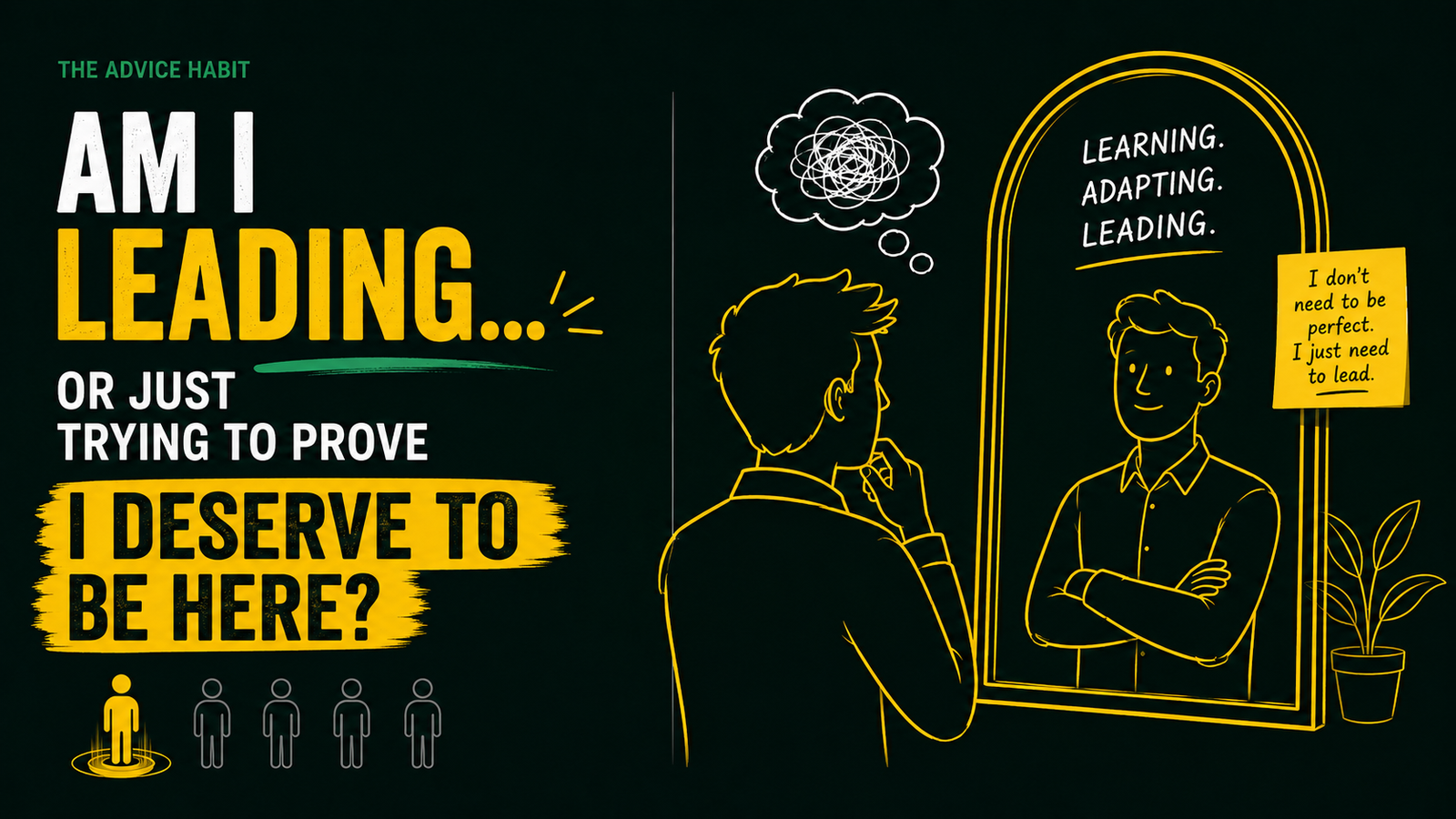
Have you ever found yourself thinking:
“I need to know the answer before my team asks.”
“I should check the work one more time, just to be safe.”
“What if I make the wrong decision?”
“Maybe I was promoted too early.”
“I can’t ask for help. Managers are supposed to know this.”
If you have experienced even one of these thoughts, you are not alone.
Becoming a manager can bring an unexpected challenge. You may have been promoted because you were capable, experienced and successful. Yet suddenly, you are expected to make decisions for others, delegate work, give feedback, handle difficult situations and provide direction.
With that responsibility can come a quiet question:
“Do I really deserve to be here?”
This is where imposter feelings can begin to influence leadership behaviour.
What Is Imposter Syndrome in Managers?
Imposter feelings refer to a pattern in which capable individuals doubt their competence and fear that others may eventually discover they are not as capable as they appear.
The experience has been observed among people at different stages of their careers and can be particularly relevant for high achievers and first-time leaders. Even when there is clear evidence of success, individuals may attribute their achievements to luck, timing or external circumstances rather than recognising their own capabilities.
For managers, the challenge is that these thoughts rarely remain internal.
They can influence how you lead.
You might start checking everything because you don’t trust yourself to let go. You might avoid difficult decisions because you are afraid of getting them wrong. You may work longer hours because you feel the need to prove yourself.
Or you might avoid asking for help because you believe managers are supposed to have all the answers.
These behaviours are not necessarily signs of poor leadership. Often, they are emotional responses to the fear of being “found out.”
How Self-Doubt Can Change the Way You Lead
The problem isn’t simply experiencing self-doubt. The bigger issue is what happens when that doubt begins to drive your behaviour.
For first-time managers, the pattern can look like this:
Thought → Behaviour → Team Experience
For example:
“If I don’t check everything, something will go wrong.”
→ Micromanagement
→ Reduced trust and autonomy
“I need to prove I deserve this role.”
→ Overworking
→ Unsustainable expectations
“I can’t afford to make the wrong decision.”
→ Decision paralysis
→ Delays and uncertainty
“Feedback means I’m failing.”
→ Defensiveness
→ Fewer open conversations
“Managers should know everything.”
→ Avoiding help
→ Isolation and slower learning
What looks like a management problem on the surface may actually be driven by self-doubt underneath.
Suggested Visual: Thought → Behaviour → Team Experience
I recommend converting this section into a branded infographic rather than presenting it as a text table. The original article already contains this framework as a visual.
The Leadership Paradox
Self-doubt does not always produce the same leadership behaviour.
One manager may respond by trying to control everything.
Their internal thought might be:
“If I don’t control everything, people will realise I’m not good enough.”
This can lead to micromanagement, reduced delegation and lower trust.
Another manager may respond by doing the opposite. They may avoid difficult decisions because:
“If I make the wrong decision, everyone will notice my mistake.”
This can lead to passive leadership, delayed decisions and reduced team confidence.
The underlying fear can be similar, but the leadership behaviour can look completely different. This is the Leadership Paradox highlighted in the original article.
This is why simply telling a manager to “be more confident” is rarely enough.
The first step is awareness.
Start With Awareness
Before trying to change your leadership style, understand your current patterns.
Ask yourself:
- When do I become most self-critical?
- What situations make me feel I need to prove myself?
- Do I struggle to delegate?
- Do I avoid decisions when the outcome is uncertain?
- How do I respond when someone challenges my decision?
- Am I comfortable asking my team or colleagues for help?
The purpose isn’t to judge yourself.
It is to recognise the situations where self-doubt may be influencing your leadership decisions.
Use Self-Assessment to Understand Your Patterns
One tool mentioned in the original article is the Clance Impostor Phenomenon Scale (CIPS). It is a 20-question self-assessment designed to provide an indication of the level of imposter feelings an individual may currently be experiencing.
Importantly, the article positions it as a behavioural self-reflection tool, not a psychological diagnosis. Its purpose is to increase awareness of patterns that may influence leadership.
The value of such an assessment is not simply the score. It is the conversation that follows:
“Are there patterns in my thinking that are influencing how I lead?”
Build Leadership Confidence Through Evidence
Confidence does not grow by trying to appear perfect.
It grows by collecting evidence that you are learning, adapting and handling leadership challenges effectively.
Here are four practical habits managers can start using.
1. Keep a Leadership Evidence Log
At the end of each week, write down three leadership decisions, conversations or challenges you handled well.
This creates tangible evidence of progress instead of allowing your attention to focus only on what went wrong.
2. Ask for Specific Feedback
Instead of asking:
“How did I do?”
ask:
“What is one thing I should continue doing and one thing I can improve?”
Specific feedback gives you information you can act on rather than simply reassurance.
3. Delegate One Decision
Delegate one decision each week without immediately stepping in to fix it.
This gives your team an opportunity to build confidence while allowing you to practise trusting their judgement.
4. Change the Question
Replace:
“I need to know everything.”
with:
“I need to keep learning.”
You don’t need to know everything to be an effective manager.
You need to be willing to learn, adapt, ask for help and make decisions despite uncertainty.
You Don’t Need to Be a Perfect Manager
Leadership confidence doesn’t mean never experiencing self-doubt.
It means recognising self-doubt without allowing it to dictate your behaviour.
You can feel uncertain and still delegate.
You can make a mistake and still be a capable leader.
You can ask for help and still be a strong manager.
And you can learn something new without treating that as evidence that you weren’t ready for the role.
The goal is not to become a perfect manager.
The goal is to become a manager who is confident enough to keep learning.
So, before your next team meeting, pause and ask yourself:
“Am I leading to prove that I belong, or because I already do?”
That question may reveal more about your leadership than you expect.
Final Takeaway
For managers, overcoming imposter feelings isn’t about eliminating every moment of uncertainty. It is about developing enough self-awareness and leadership confidence to recognise when those feelings are influencing your decisions, delegation and relationships.
The next time you feel the need to check everything, avoid a decision or prove that you have all the answers, pause.
Ask yourself:
“Is this what the situation requires—or is this what my self-doubt is asking me to do?”
Because confident leadership isn’t about having all the answers.
It is about being secure enough to keep learning.