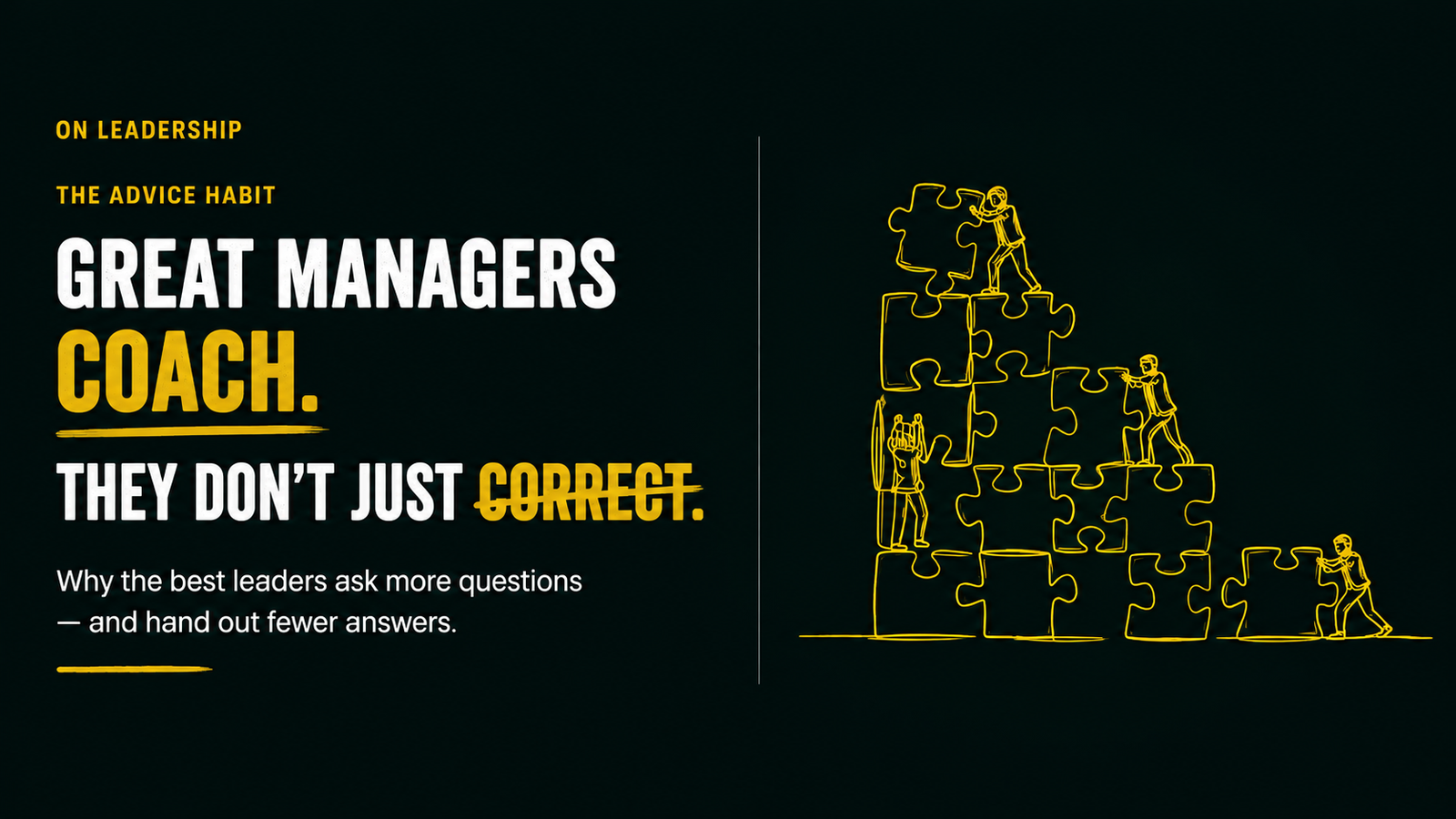
Great Managers Coach. They Don’t Just Correct.

Have you ever thought:
“It’ll be faster if I do it myself.”
Maybe you solved a problem instead of asking your team member to think it through. Or perhaps you took the work back because a deadline was approaching and you were worried the result wouldn’t meet expectations.
Most managers have been there.
When you become a manager after years of being known for having the answers, that habit can easily follow you into leadership. But effective managers create value differently. Their role is not simply to solve problems. It is to build people who can solve problems independently.
Instead of always giving answers, great managers help their teams think, experiment, make decisions and take ownership.
The Advice Habit: When Helping Becomes Holding Back
One of the most common challenges managers face is the instinct to immediately give advice.
When an employee approaches with a problem, it can feel natural to say, “Here’s what you should do.” After all, you have the experience and may already know the solution.
It might even save time today.
But consistently providing solutions can create an unintended consequence: employee dependency.
When managers always solve problems for their teams, employees get fewer opportunities to develop their own problem-solving and decision-making skills.
Michael Bungay Stanier describes this tendency as the “Advice Habit”: our instinct to jump in with solutions rather than helping others think through their challenges.
The better question is:
“Am I solving the problem, or am I helping the person become better at solving problems?”
The next time deadlines are tight, mistakes happen, or your first instinct is to take the work back, pause and ask yourself:
“What is driving my response: trust or fear?”
Are You Leading From Fear or Trust?
Sometimes the fear is obvious:
“What if the work doesn’t meet expectations?”
“What if the deadline is missed?”
“What if my team’s performance reflects poorly on me?”
Sometimes it sounds much more practical:
“It will be quicker if I do it myself.”
These reactions are common. But over time, they influence how your team learns, performs and takes ownership.
Leading from fear can look like:
- Solving the problem yourself
- Focusing heavily on avoiding mistakes
- Checking every detail
- Giving answers quickly
- Taking responsibility back from employees
Leading from trust looks different:
- Helping employees solve problems themselves
- Focusing on learning rather than simply avoiding mistakes
- Agreeing on outcomes and giving appropriate space
- Asking questions before offering advice
- Treating mistakes as opportunities for learning
Suggested Visual: Leading From Fear vs Leading From Trust
I recommend converting the two lists above into a side-by-side branded infographic, with fear-based behaviours on one side and trust-based behaviours on the other.
Trust does not mean lowering standards or ignoring mistakes.
It means believing that people can grow with the right support and opportunities to take ownership.
Why Employee Ownership Matters
A coaching approach is not simply about being supportive. It can also help create conditions in which employees become more motivated and take greater ownership.
Self-Determination Theory, developed by Edward Deci and Richard Ryan, highlights three psychological needs: autonomy, competence and relatedness.
1. Autonomy: Give People Ownership
Employees need opportunities to have ownership over how they approach their work.
Instead of telling someone exactly how to complete a task, ask:
“What approach do you think would work best?”
This gives employees space to contribute their own thinking and take responsibility for the outcome.
2. Competence: Build Capability
Employees build confidence when they develop the skills needed to succeed.
Instead of immediately fixing a problem, a manager can coach the employee through the situation.
The objective is not just to complete today’s task.
It is to help the employee become more capable of handling the next one.
3. Relatedness: Support Without Micromanaging
Coaching does not mean leaving employees completely on their own. Managers still need to be available, provide support and make time for meaningful conversations.
The difference is that support does not have to become micromanagement.
A manager can be available when needed while still allowing employees space to think and act independently.
Before You Step In, Coach: The GROW Model
One practical framework for developing coaching skills for managers is the GROW coaching model. It helps managers structure conversations instead of immediately providing solutions.
GROW stands for Goal, Reality, Options and Way Forward.
G — Goal
Clarify what the employee is trying to achieve.
Ask: “What are you trying to achieve?”
R — Reality
Explore what is happening right now.
Ask: “What is happening at the moment?”
O — Options
Explore possible approaches.
Ask: “What options do you have?”
W — Way Forward
Turn the conversation into action.
Ask: “What will you do next?”
Together, these questions help employees examine the situation, generate their own ideas and take responsibility for the next step.
Suggested Visual: The GROW Model
I recommend presenting the four GROW stages as a branded four-step infographic, with each stage paired with its key coaching question.
What Does Coaching Look Like in Practice?
Imagine a team member comes to you and says:
“I’m stuck. Can you tell me what I should do?”
The traditional managerial response might be:
“Here’s what you should do…”
A coaching response could look different:
Goal: “What are you trying to achieve?”
Reality: “What’s happening right now?”
Options: “What choices do you think you have?”
Way Forward: “What do you think you should do next?”
Notice what has changed.
The manager hasn’t ignored the problem. They haven’t lowered the standard. And they haven’t abandoned the employee.
They have helped the employee think through the problem.
That is the shift from manager as problem-solver to manager as coach.
You Don’t Have to Coach Every Conversation
Not every situation requires a full GROW conversation.
Sometimes an employee needs a direct answer. Sometimes the manager needs to make the decision. And sometimes there simply isn’t enough time for an extended coaching conversation.
The goal isn’t to stop giving advice.
The goal is to stop making advice your automatic response.
Even asking one thoughtful coaching question before giving advice can help employees build confidence and strengthen their decision-making over time.
Try asking:
- “What have you tried so far?”
- “What do you think is causing this?”
- “What options do you see?”
- “What would you recommend?”
- “What support do you need from me?”
A single question can shift the conversation from dependency to ownership.
From Expert to Coach
One of the biggest shifts in leadership happens when managers move from being the person with all the answers to being the person who helps others find better answers.
As an expert, your value may come from knowing the answer and doing the work well.
As a manager, your value increasingly comes from helping others become capable of doing the work well.
This is why great managers don’t only ask:
“How many problems did I solve today?”
They also ask:
“How many problems can my team now solve without me?”
Final Takeaway
The next time a team member brings you a problem, resist the urge to immediately take over.
Pause.
Ask a question.
Create space for them to think.
Then decide whether they need coaching, guidance or a direct answer.
Great management isn’t about being the person with all the answers.
It’s about building a team that doesn’t always need you to have them.